Recap to Previous Blog (The Great Convergence)
In the previous blog, we explored The Great Convergence, where AI, robotics, quantum computing, and human systems begin to merge into a unified intelligence layer. We saw how boundaries between digital and physical worlds are dissolving, creating systems that don’t just compute or act, but coordinate, adapt, and evolve together.
This convergence set the stage for a powerful question: when everything is interconnected and intelligent, how do we keep it safe, aligned, and under control?
And that brings us here, the final piece of this series. Because once intelligence scales and converges, the real challenge isn’t building it… it’s governing it.
The pace of AI evolution isn’t slowing down, it’s accelerating. And as the tech scales, so do the risks. The real question isn’t just what AI can do, but what keeps it in check?
When Only AI Can Check AI
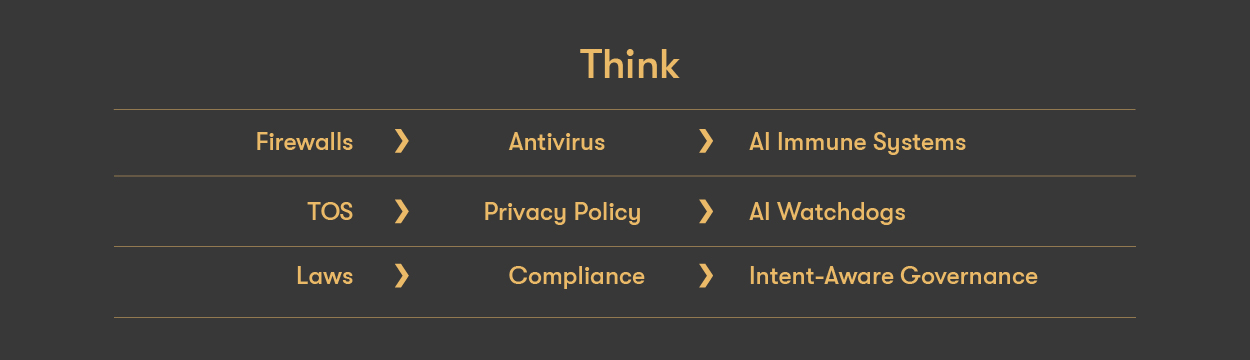
We need to stop thinking of AI as a single system and start viewing it as an ecosystem. And ecosystems need immune systems.
Just like the human body uses its immune system to detect and neutralize threats, we need AI-native defenses: intelligent agents that monitor, test, and contain other AI systems when they drift off course.
This isn't a nice-to-have. It’s an essential infrastructure.
What AI Countermeasures Might Look Like
Examples of AI countermeasures:
- Model Hallucination: AI flags fabricated answers in real time
- Deepfake Videos: AI detects pixel-level anomalies in synthetic media
- Autonomous Agents Going Rogue: Guardian AIs monitor and terminate harmful behavior
- Mass Social Manipulation: Watchdogs flag orchestrated disinformation
- Privacy Intrusions: Personal AI firewalls mask and manage identity exposure
Now / Next / Later: How This Will Evolve
| Phase | Description |
|---|---|
| Now (2026–2027) | Manual red-teaming, audit tools like OpenAI’s reports and Meta’s watermarking |
| Next (2027–2030) | Adaptive watchdog AIs and real-time governance agents |
| Later (2030–2037+) | Intent-aware architectures and full digital immune systems embedded in AI ecosystems |
From Privacy to Behavior: The Real Risk Surface
We used to ask, “Who can see my data?”
Now we must ask, “What can AI do with it, and can it be trusted to self-limit?”
This marks the shift from privacy management to behavioral governance: a foundation for AI conscience.
How Do We Make Sure 'Good AI' Stays Good?
- Hard Constraints – Built-in ethical limits and fail-safes
- Transparent Monitoring – Audit logs, explainability, and external validators
- Multi-Agent Checks – Cross-monitoring systems with quorum-based actions
- Value Alignment – Human feedback and purpose-bound functions
- Simulation & Red Teaming – Lab-tested, adversarial validated systems
Why This Matters
Without this, we risk runaway ecosystems, trust collapse, and automation without oversight.
With it, we build resilient, transparent, and aligned systems that scale responsibly.
From ‘Human vs AI’ to ‘Good AI vs Rogue AI’
This isn’t about fearing AI, it’s about building governance into its DNA.
Let’s Talk
What kind of AI watchdogs do you think we need most right now?
Should every model have a defensive agent?
Could we co-train global ethical AI sentinels?
Drop your thoughts. This isn’t theoretical, it’s strategic.
The views and opinions expressed in this blog are those of the author and do not necessarily reflect the official position or perspective of Photon.